Alternating bands, aligned or offset
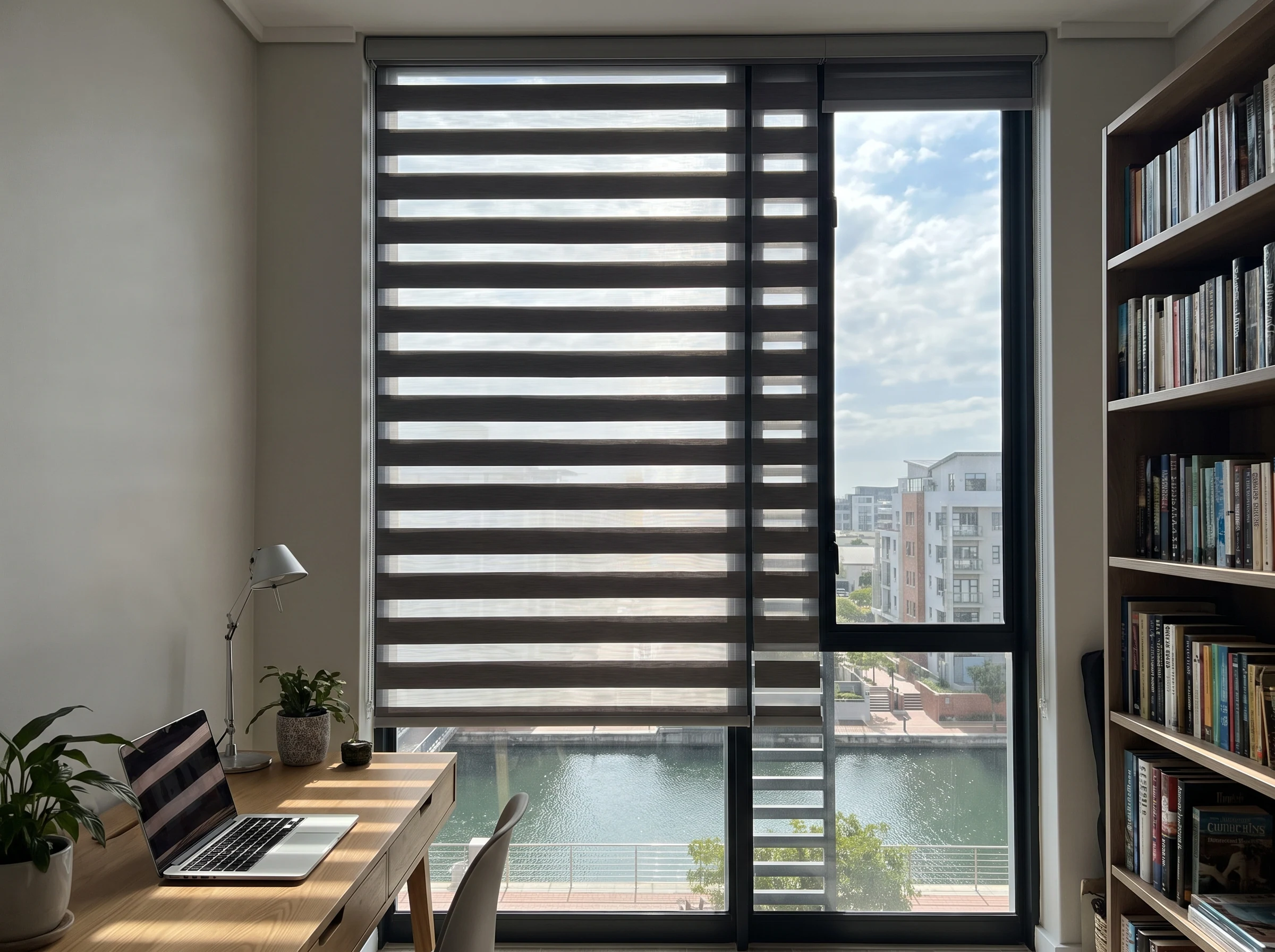
A day-night blind runs two fabrics — usually one sheer, one solid or semi-solid — as alternating horizontal bands on a continuous loop. Align the bands and you get filtered light with the canal still visible through the sheer strips; offset them and the solid bands close over the gaps for near-total coverage. It's one product doing the job a sunscreen and a curtain would otherwise split between them, which matters in an apartment where every extra layer takes up floor and sill space you don't have.
Built for Century City's two-source glare
Most day-night installations are sold on privacy-with-view for a street-facing window. In Century City the more common brief is glare management: direct sun through north-facing glazing for most of the day, plus low-angle light reflecting straight off the canal in the early morning and again toward evening. Tuning the bands through the day — more open at midday when the sun is overhead, tighter as it drops toward the water — does a genuinely different job than a fixed sunscreen mesh set once and left alone.
Where it earns its place, and where it doesn't
Living rooms, dining areas and home studies with a canal or courtyard aspect are the sweet spot — exactly the rooms where you want to keep working or entertaining without staring straight into reflected glare. It's not a true blockout even fully offset, since light still finds its way through at the band edges, so a bedroom that needs proper dark is better served by a blockout roller (see roller blinds) or a double-roller combination instead. The sheer bands are also a little more delicate at reach height than a solid roller fabric, worth knowing if there's a toddler or a cat that likes to test things.
The same window faces the sun once and the canal's reflection of it a second time — a day-night blind is the one product built to answer to both without going fully dark.
On-site measure, Century City- Alternating sheer and solid horizontal bands
- Tuned through the day for direct sun and canal-reflected glare
- Best in living rooms, dining areas and studies — not true blockout for bedrooms
- Standard roller hardware — chain or motorised, cassette optional
Day-night blind pricing, per square metre installed
A day-night blind holds twice the fabric of a plain roller and the banded weave is more work to make, so the band starts higher: R1,300 to R2,000 per square metre installed hand-operated, and R2,800 to R4,000 per square metre motorised. Broader bands, a hood over the roll and a semi-blockout backing all push a window towards the upper figure.
These are planning bands rather than a quotation. Small windows carry a minimum charge, because the brackets, tube and fitting time barely change with the opening. Each window in your home is worked out separately at the measure and confirmed on paper.
Ready to measure your windows?
We measure free, price every window in writing, and leave the decision with you.