Home / The Guide
Six Kinds of Glass
A free guide to shading a Century City apartment. A house has elevations. A flat has an inventory — six recurring window types, each with its own job — and once you can name yours, the rest of this is straightforward.
Prefer to read this on paper, or keep it? Download the whole guide as a PDF (1.1 MB).
Nearly every shading article you will find was written for a freestanding house: walk the compass, work out which wall is the hot one, buy accordingly. In an apartment none of that is available to you. You cannot change the orientation, you cannot plant a tree, and you did not choose the glazing. What you have instead is a fixed set of openings, and each of them behaves the same way in every block in this precinct. No figure on this page is asserted without a trail: each one is either footnoted below or arrived at by arithmetic from the precinct's latitude.
A precinct, not a suburb
Century City is a mixed-use development of roughly 250 hectares about ten kilometres north-east of the Cape Town city centre, alongside the N1. Building started in 1997 and has never really stopped; the precinct now holds more than five hundred businesses and something in the region of three and a half thousand homes, threaded throughout by waterways, wetlands and canals.1
The water is engineered, not incidental. At the middle of it is Intaka Island, a sixteen-hectare wetland and bird sanctuary whose reed beds clean the canal water naturally, set inside a canal system running roughly seven kilometres around the precinct. The wetlands were built in 2001 after an environmental assessment recommended a reserve, and the island now carries over two hundred indigenous plant species and around a hundred and twenty bird species.2
Three consequences shape every quote we write here, and none of them are about weather:
- Nothing is old. There is no heritage joinery, no deep plastered reveal, no century-old timber frame. There is a lot of large aluminium-framed glazing, much of it running floor to ceiling, and it is remarkably consistent from block to block.
- There is water at ground level almost everywhere. Not a bay in the distance — a canal a few metres below your floor. That behaves differently from a beach, and section three is about how.
- There are no gardens to borrow shade from. A house gets a certain amount of free shading from its own trees, walls and neighbours. Here your neighbour is a building of similar height across a canal, which does something quite different to your light.
The six kinds of glass
Walk any flat in this precinct and you will find some combination of these six. They are worth naming, because each one has a different failure mode and a different answer, and because you can then tell a consultant exactly what you have over the phone.
One — the full-height canal slider
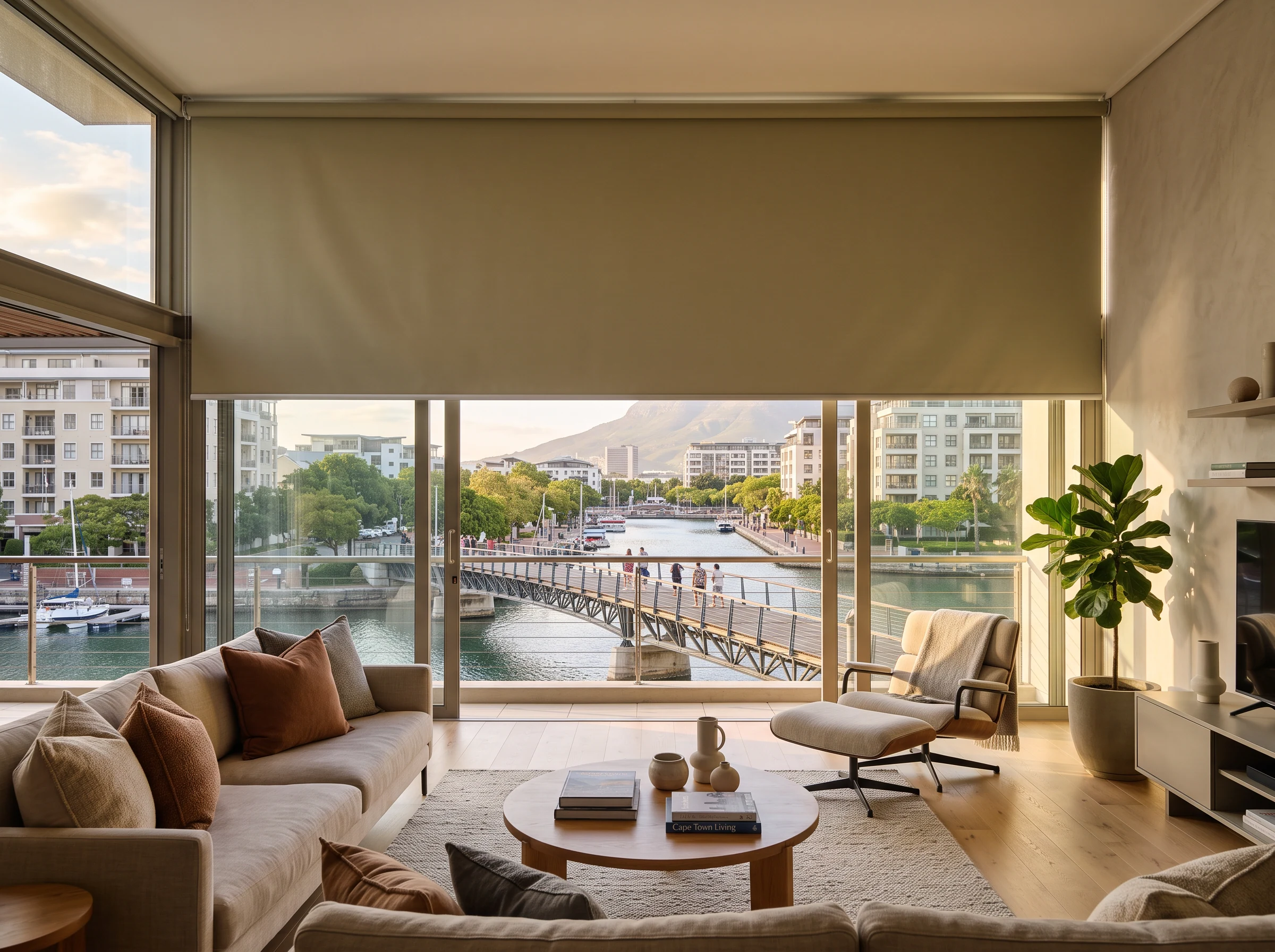
The showpiece: floor-to-ceiling glass onto the water, usually with a sliding leaf in it, usually the widest opening in the flat. Three things go wrong with it. The span is often wider than a single blind should carry, so it wants either a split with a join line or a linked, motorised pair rather than one chain doing three or four metres of work. The sliding handle decides the fit, and a blind that fouls the handle is a blind you stop using. And a half-lowered roller solves almost nothing here, because the light you are actually complaining about is coming in below where you stopped it.
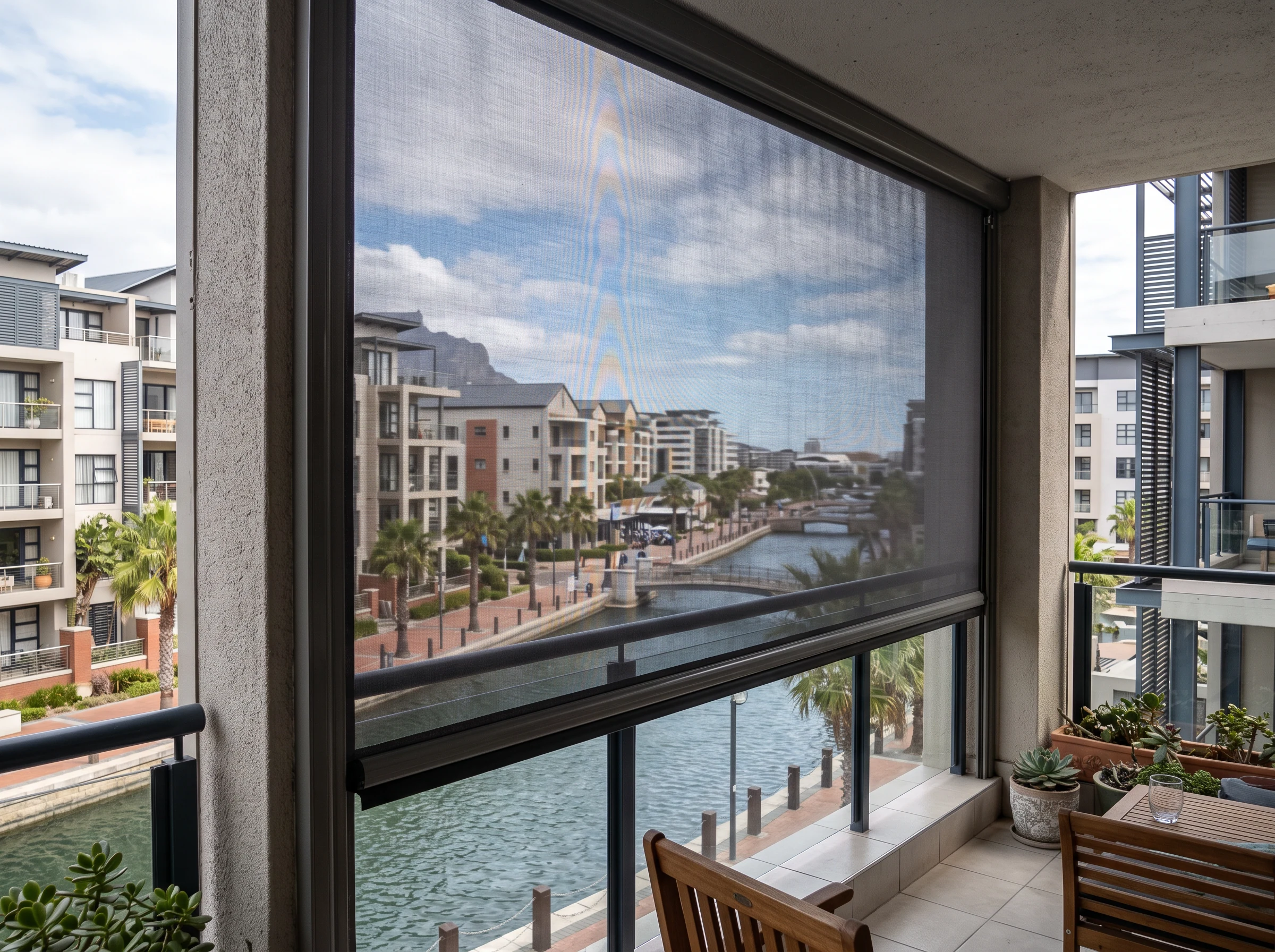
What we fit: a low-openness sunscreen mesh, three to five per cent, run full height rather than half-drawn, so the whole pane is filtered and the canal stays legible through the weave. Where the room also has to close down at night, a double roller carries a blockout layer behind the mesh on the same bracket.
Two — the recessed balcony opening
Set back under the slab of the flat above, so it has a built-in overhang. That overhang is genuinely useful at midday and completely useless in the late afternoon, when the sun is low enough to walk underneath it. It also creates the trap that catches people out: the room feels shaded for most of the day, so nobody specifies for it, and then two hours a day are unusable.
What we fit: something at the opening rather than at the glass. This is where the exterior range belongs — a zip screen dropped across the open end, or an external venetian tilted against the low sun. Section four covers the approval side of that honestly.
Three — the bedroom window on the quiet side
Usually smaller, usually facing a courtyard, a parking deck or another building, and almost always the one people complain about first — not for heat, but because it never gets properly dark and because somebody can see in.
What we fit: blockout, and then a decision about how it is fitted, because that is what actually decides the darkness. Nobody is ever woken by fabric — all blockout cloth is opaque. They are woken by the perimeter, and apartment reveals are shallow enough to leave a lot of it exposed. Sit it in the reveal and it looks best, with a lit seam down each edge. Hang it across the front of the opening and it is far darker, at the price of covering the frame. Put it in the reveal and add side channels and the seam disappears, along with a little more of your budget. Name the one you are after and the number stops being mysterious.
Four — the internal courtyard or light-well window
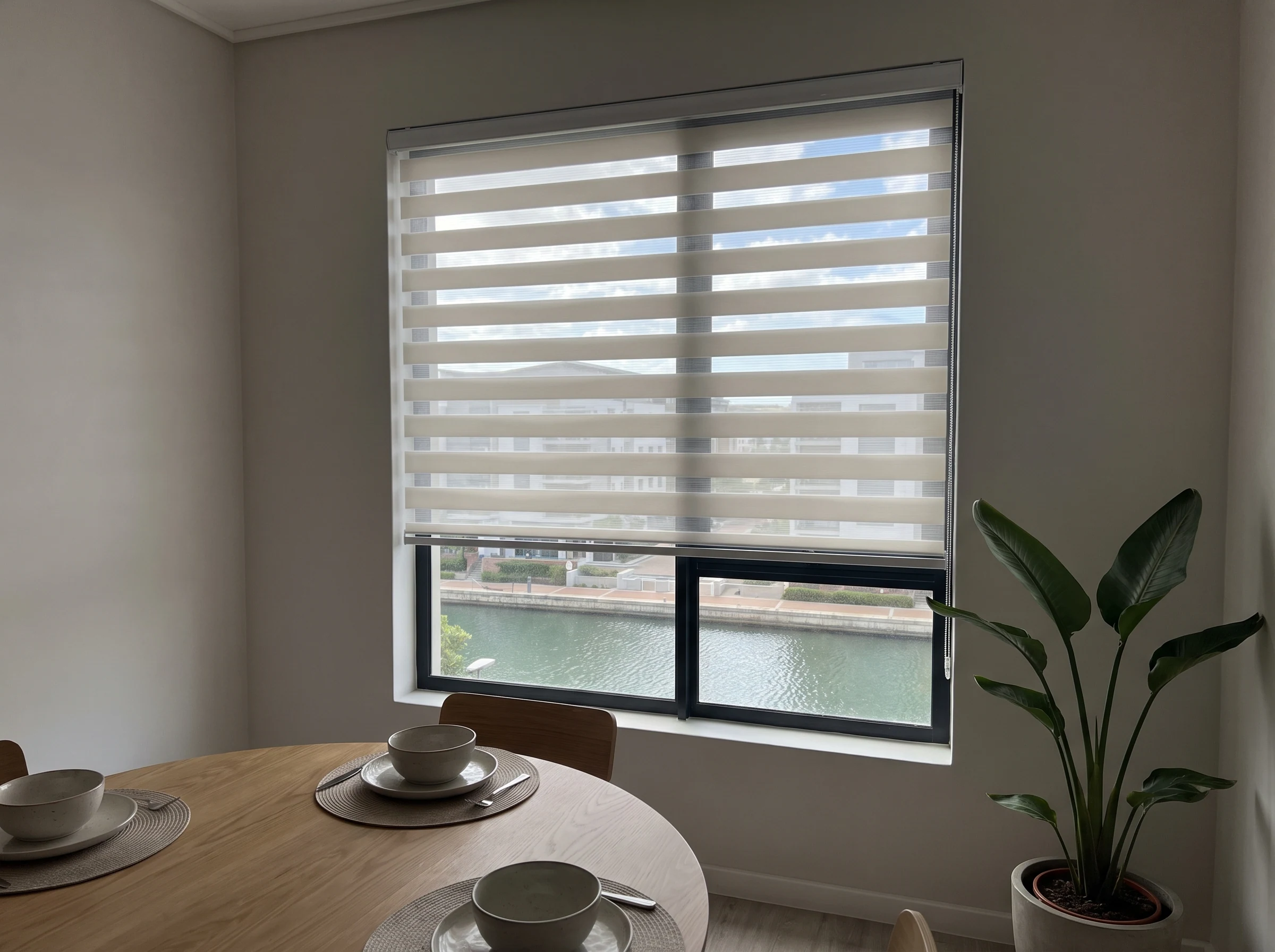
The one nobody writes about. It gets almost no direct sun, so it is never a heat problem — and it is a serious privacy problem, because it looks across a short gap at somebody else's identical window, often at the same height. Blockout here is overkill and makes the room feel like a cupboard.
What we fit: banded day-night fabric, or a cellular blind raised from the sill upward. Both close the eye-level band and leave daylight coming over the top, which is exactly the right compromise for a window whose only fault is that it faces a neighbour.
Five — the small high one
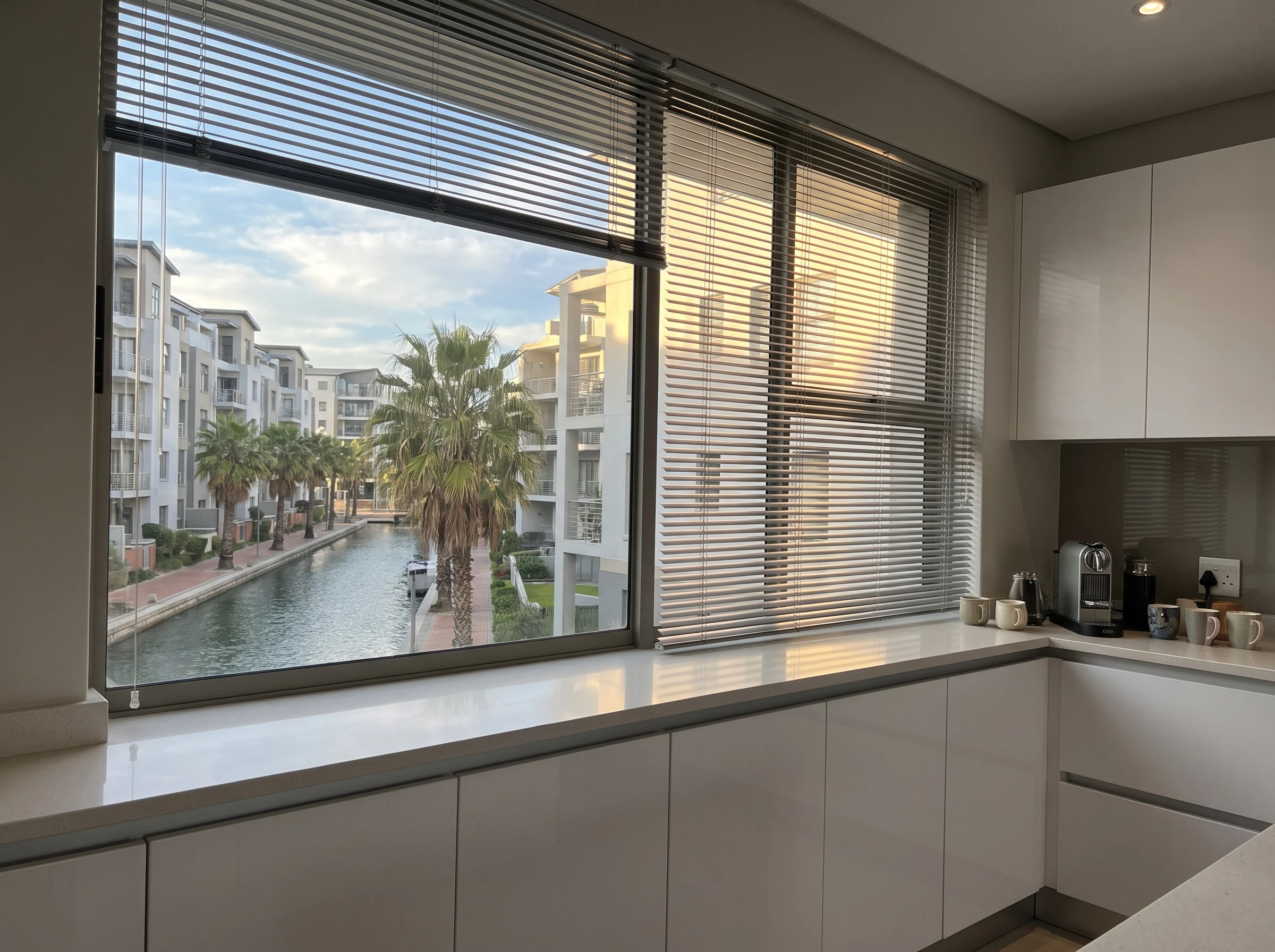
Above a kitchen counter, or high on a bathroom wall, usually obscure-glazed and usually left bare because it seems harmless. It is not entirely harmless: on a west wall it is a small heat source into a small room, and in a bathroom it is the surface most likely to run with condensation.
What we fit: aluminium venetians on a wand. They take steam and a wet cloth, they tilt rather than raise, and they cost very little for the amount of nuisance they remove.
Six — the one you cannot reach
Tall glass above a fixed balustrade, a stairwell in a duplex, or the upper half of a double-volume living room. A chain hanging three metres up is decoration, not a control, which is why these windows are so often left permanently open and quietly fade the floor beneath them.
What we fit: motorisation, without much debate. And once there is a motor, a schedule is nearly free — a blind that closes itself in the late afternoon whether or not anyone is home is the single most effective thing you can do about fading and afternoon heat in a flat that stands empty during the working day.

What the canal does to the light
Start with the plain arithmetic. The arithmetic first, worked by hand from 33.89° south and a 23.4° axial tilt. Noon in December puts the sun near 80° up. Noon in June leaves it at about 33°, sitting due north. The December sun goes down some 28° to the south of due west, and the June sun about 29° to the north of it.
Living areas here are often laid out facing north onto the water, which is sound design: it collects winter sun and turns the main glass away from the worst of the summer south-easter. What it also produces is a light problem in three parts, and only one of them is the sun itself.
The canal is a mirror, and it is close
This is the part that behaves differently from a beachfront. Water reflects an increasing share of the light striking it as the sun drops toward the horizon, and the reflected ray leaves at the mirror image of the angle it arrived at. On an open coast the water is far away and the reflection comes in shallow and travels deep into a room. On a canal a few metres below your balcony, the geometry is much steeper: the light comes up off the water at a sharp angle and lands on your soffit and your ceiling — which is why a Century City living room can be uncomfortably bright with the sun nowhere in the window, and why people so often blame the blind for a problem it was never covering.
Neighbouring glass does its share
In a precinct this densely built there is frequently a large glazed facade across the water from you. For part of the year, for part of the day, it will throw a slab of light straight back at your windows. It is seasonal and it moves, which is exactly why it gets mis-diagnosed as a fault rather than a fact.
And the overhang runs out
A balcony slab is a fine sunshade in December and does nothing whatsoever in June, when the noon sun sits at a third of the height. Any product chosen on a summer impression will disappoint in winter.
The practical rule for canal-facing glass: ask what a product does about light that is not coming through the top of the window. Full-height sunscreen mesh, banded fabric set low, and bottom-up cellular blinds all answer that. A roller stopped halfway down does not, and that is the most common disappointment we are called out to look at.
- Anything fitted inside the reveal or on the inner face of the wall
- Sunscreen, blockout, double rollers and banded day-night fabric
- Cellular blinds, aluminium venetians, panel and vertical tracks
- Battery or wired motorisation of any of the above
The balcony, and getting a yes
External shading is not an upgrade tier. It is different physics. Once light has crossed a pane it is heat inside the room, and an interior blind then absorbs it and radiates part of it back in — very effective on glare, only partly effective on temperature. Something at the balcony opening intercepts the energy before the glass ever warms, which is the difference between a balcony room you can sit in at six on a February evening and one you give up on until seven.
In a managed precinct that work sits on the outside of the building, so it goes through the trustees rather than through you alone. Treat it as an application rather than an argument and it usually goes well.
The four products, and how each behaves here
Zip screens
Mesh carried on a continuous zip that runs inside an aluminium channel each side, so nothing along the edge is free to move; it rolls fully back into its cassette. The strongest all-round answer on a Century City balcony, and the easiest to make look consistent across a building.
External venetian blinds
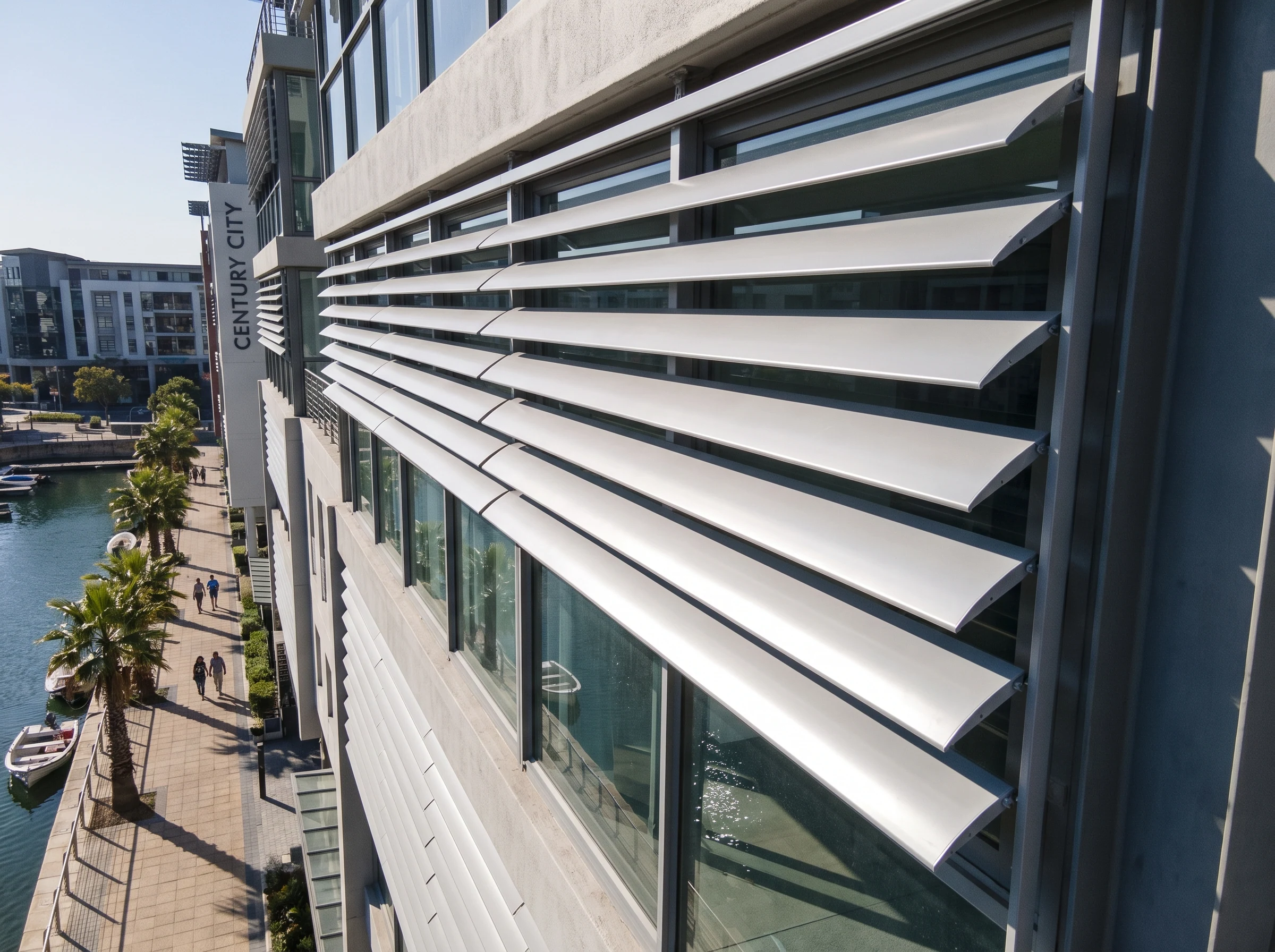
The only exterior product that can be aimed. Tilted, they hold the low sun off the glass while you can still see the canal beneath them. The most wind-sensitive of the four, so it wants a sensor and a sheltered aspect.
Roller shutters
Rigid slats in a fixed guide rail — the most robust and the best at rejecting heat, and also the most visible as a piece of building, so the one most likely to need a full application. Shading is what it is for; it is not sold or rated here as a security product.
Balcony awnings
Retractable and gone entirely when the winter sun is welcome back. The honest trade-off: an awning's outer edge floats, which is what lets it fold away and also what the wind takes hold of. On an exposed balcony it is the most vulnerable of the four, and it must retract automatically.
Wind between buildings
The precinct sits on flat, open ground, and the Cape summer south-easter is a fixture here from about October to March.4 A dense precinct does not simply shelter you from that: air squeezed between tall blocks accelerates, so a balcony on a corner or facing a gap between buildings can be measurably windier than the open ground beside it. Two flats in the same building can have entirely different experiences of the same afternoon, which is why exposure is judged on site rather than from a floor plan.
A wind rating on a datasheet describes a sustained wind. What damages an exterior product is the gust, which runs well above the average you were feeling a minute earlier. So the component that matters is an anemometer wired to the motor, retracting the fabric before the gust arrives — which we fit as standard rather than offering as an extra line. And on an exposed balcony we will recommend a product held in a channel over one with a free edge, every time.
Four things that make an application easy to approve
- A colour already on the building, named as a specific finish reference rather than described as "charcoal".
- A product that retracts, so the elevation returns to normal when it is not in use.
- A slim, repeatable profile the next owner could match, so the facade does not become a patchwork.
- Proper documentation — dimensions, fixing detail, colour reference and an image of the installed condition — rather than a verbal request at a meeting.
What we will and will not do. We check your building's position before quoting rather than after, and we prepare all four of the items above. We will not submit the application for you, and we will not tell you it is a formality. Where consent is not going to come, we will say so and put the best interior answer on the table instead — which, for most of the six windows in section two, was always the right answer anyway.
If you are renting
A large share of homes in this precinct are let, and tenants are usually told nothing useful about windows at all. Three things worth knowing before you buy anything:
- Anything screwed into a wall is an alteration to somebody else's flat. Get written agreement from the landlord first, however small the job. Most say yes to a well-chosen blind because it improves the flat — but a message sent afterwards is worth nothing.
- Fixtures generally stay. As a rule, something fixed to a property becomes part of it, so a blind you screw up is not something you take with you unless the lease says otherwise. If you want the value back, agree that up front or ask the landlord to contribute.
- The landlord often should be paying anyway. A flat with bare glass on the hard elevation is harder to let and harder to keep let. A short, factual message describing the problem with a quote attached is far more persuasive than a complaint, and we are happy to address the quote to the landlord directly.
Where none of that is workable, there are genuine no-damage options: tension-fitted and no-drill systems that clamp inside the reveal, and free-standing screening. They are more limited than a fitted blind and we would rather say so plainly than pretend otherwise — but for a two-year lease they are frequently the sensible answer.
Five answers we cannot give from here
Nothing above required us to see your flat. These five do:
- The frame profile you actually have. Apartment aluminium comes in many sections, and yours decides whether a headbox fits inside the reveal, whether side channels are possible, and how a blind clears the sliding-door handle.
- The gap between window head and ceiling. On floor-to-ceiling glazing there is often almost none, and that decides between a face-fixed headbox, a recessed box and a ceiling track.
- Which way your particular unit faces, and what is opposite it. Not the building's orientation — yours. A glazed facade across the canal changes the brief entirely.
- How exposed your balcony really is. A recessed balcony mid-block and a corner one facing a gap between buildings are different jobs, and that settles awning against zip screen.
- Your building's rules, and the nearest circuit. What the trustees expect for anything outside the glass, and how far a motor sits from live power once the ceiling is closed and painted.
Five answers, one appointment, no charge — because a wrong assumption here gets paid for in a remake rather than in a phone call.
Get your own inventory written up
A consultant walks the flat, names each of the six windows you actually have, takes the frame profile and the balcony condition, and sends an itemised quote in writing — with any body-corporate step flagged rather than skipped.
Where to read more on each
Tell us which windows you have
Name the ones from section two that sound like your flat, and one of our expert consultants will contact you shortly to arrange your free in-home measure.
- No obligation, no call-centre — a consultant calls you directly
- Body-corporate steps flagged before the quote, not after
- Written, itemised quote before anything is ordered
What this is built on
Nothing above about the precinct, the water or the sun is asserted without a trail back to one of these. Anything arrived at by arithmetic is labelled as such.
- Century City, Cape Town — a mixed-use development of about 250 hectares roughly 10 km north-east of the Cape Town CBD along the N1; development begun in 1997; more than 500 businesses and around 3,500 residential homes; the precinct traversed by waterways, wetlands and canals. en.wikipedia.org — Century City and centurycity.co.za — history
- Intaka Island — a sixteen-hectare wetland and bird sanctuary inside the precinct whose reed beds filter the canal water naturally, set within a canal system of roughly seven kilometres; the wetlands engineered in 2001 following an environmental assessment; more than two hundred indigenous plant species and around a hundred and twenty bird species recorded. intaka.co.za and capetown.travel — Intaka Island
- Solar geometry — calculated, not cited. The four angles used in section three — two solstice noon altitudes and two sunset bearings — are arithmetic from 33.89° S and a 23.4° axial tilt. They belong to the latitude rather than to Century City, and nothing local was measured to obtain them.
- The Cape Doctor — the Cape's south-easterly summer wind, and its documented habit of accelerating wherever the landscape or the buildings narrow its path. capetownmagazine.com/cape-doctor
- Reflection off water and glass. That a water surface reflects a growing share of the light striking it as the sun approaches the horizon, that the reflected ray leaves at the mirror of the angle it arrived at, and that this puts canal-reflected light onto soffits and ceilings rather than deep into a room, is standard optics applied to the local geometry. The mechanism is standard; the magnitude in any particular flat is not something we have measured, so we have not put a number on it.
- Approvals in a managed precinct. That work on the outside face of a building in a sectional-title scheme goes through the trustees, and that Century City also has precinct-level rules and regulations administered by a property owners' association, is a plain description of how the precinct is run rather than legal advice. Your own scheme's registered rules govern your unit. centurycity.co.za
The recommendations here are our working opinion, given free. Nothing on this page decides anything about your building — your trustees, your managing agent and your own advisers do that.